Three Parts-Washing Problems. Three I-Series Solutions
“If you have high volume, it’s the only way to go, because it’s continuous.”
— Dave Barney, President
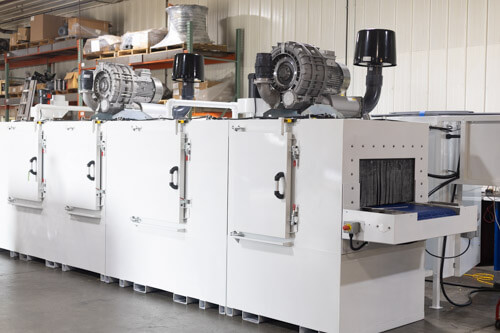
That is where Renegade’s I-Series Pass-Through Parts Washers fit.
But conveyor washing is not as simple as choosing a belt width and adding wash, rinse and dry stages.
Three recent I-Series projects had the same basic goal: continuously clean parts and prepare them for the next step in production.
Yet each customer brought a different problem.
One needed a highly specified system designed around maximizing uptime, minimum downtime, filtration, oil management and material handling.
Another knew the result they needed but relied on Renegade to determine the right cleaning process.
A third had a stringent cleanliness requirement where machining chips, cutting fluids and cross-contamination between stages all had to be controlled.
All three ended up with an I-Series.
None ended up with the same machine.
That is because Renegade starts with the process, not a predetermined washer configuration.
What Does the Part Need to Look Like When It Comes Out?
One of the most important questions Renegade’s Sales and Engineering teams work through is:
What needs to happen to the part before it can move to the next step?
- Size of part and their configuration
- How clean does it need to be?
- How dry?
- What is being removed?
- How many parts need to move through the system?
- What happens immediately after cleaning?
- Does the process need to control oil, prevent carryover between stages, integrate with automation or fit within a limited footprint?
Sometimes the customer already knows exactly what they want.
One of these manufacturers came to Renegade with a detailed equipment specification that included requirements for filtration, oil management, mist collection, part handling and other features.
Another approached the project very differently.
“We’re replacing a parts washer due to age. You tell me what I need because it works for you.”
— Derek Tylka, Sales Engineer
That customer knew the desired result but did not arrive with the cleaning process already engineered.
So Renegade listened to the customer’s requests, provided inputs on improvements, and both parties came up with the solution
Those two starting points were very different.
The goal was the same: understand what the process required and design the washer around it.
Challenge 1: Keep Production Moving — Even During Routine Maintenance
For the highly specified system, uptime was an important part of the overall design.
The customer knew it needed filtration.
The bigger question was how to maintain that filtration without unnecessarily interrupting production.
The Solution: Duplex Continuous Filtration
Renegade incorporated true duplex filtration into the system.
Rather than relying on a single filter that requires the washer to stop when it is serviced, duplex filtration allows the operator to redirect flow from one filter to another.
One filter stays in operation while maintenance services the other.
Then the process can be reversed.
For someone standing back and looking at the finished machine, that may not be the most visually impressive feature.
For the person responsible for keeping production running, it can be one of the most valuable.
Derek described the ability to change filtration “on the fly” as one of the standout features of the system.
The same thinking extended to waste handling.
Instead of relying on an operator to continually empty a small container collecting oil and waste, the system incorporated a waste tank and discharge pump so collected material could become part of a more automated process.
The requirement drove the engineering decision:
Reduce routine interruptions and make the washer work within the customer’s larger production process.
The Washer Also Had to Fit the Material-Handling Process
The parts washer was only one piece of this production line.
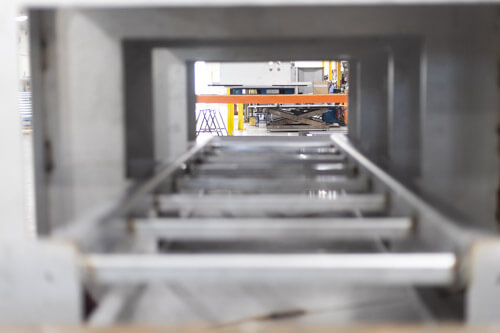
The customer also needed additional conveyors before and after the I-Series machine.
That introduced another challenge: moving the part smoothly from one conveyor to another.
Most Renegade conveyor washers move the part through the machine on one continuous belt. Adding separate infeed and exit conveyors creates transition points.
And a small transition can create a surprisingly large engineering problem.
“You don’t realize how much a three-inch gap makes a huge difference.”
— Tyler Mason, Engineer
The transitions had to be engineered around the actual part so it could move fluidly from the material-handling equipment into the washer and back out again.
The requirement was not simply: Build a washer.
It was: Build a washer that works as part of the production line.
Challenge 2: The Customer Knew the Result — Renegade Had to Determine the Process
The second project started with far fewer specifications.
The customer was replacing an existing washer as part of a move to a new facility.
Rather than prescribing every stage and component, they relied on Renegade to recommend the right process.
The part needed to meet the required cleanliness level and leave the machine very dry.
Those requirements led Renegade to a:
Heated Wash → Rinse → Blowoff → Heated Dry
The heated wash removes contamination (bulk cleaning).
The rinse helps remove remaining wash solution and any minor contaminant residue.
The blowoff removes the majority of the water droplets, very similar to your car wash.
The heated dry addresses the final dryness requirement, providing DND (Darn Near Dry).
The machine configuration came from the desired result.
The Oil Created Another Requirement
The application also involved excess oil.
A traditional oil skimmer works when oil separates from the cleaning solution and rises to the surface.
But not all oil behaves that way.
Some applications can create emulsified oil that remains mixed throughout the wash solution.
For this system, Renegade incorporated oil coalescing to help separate that oil from the water and help maintain the cleaning process.
The point is not that a coalescer is always better than an oil skimmer.
The contamination determines the remedy.
That is what this project demonstrates particularly well.
Challenge 3: Get the Part Clean — Without Carrying the Problem Into the Next Stage
The third application involved a machined casting.
Machining operations leave the part carrying chips, cutting fluids and other contamination.
Before the part could continue into pressure testing and the next production steps, it had to meet a stringent cleanliness requirement.
That meant the engineering problem was bigger than simply spraying the contamination off the part.
Renegade also had to control what happened between the wash and rinse stages.
“One of the big things with wash and rinse is cross-contamination. You don’t want your wash tank to fill with your rinse water and vice versa.”
— Tyler Mason, Engineer
When a freshly washed part leaves the wash zone, it is still carrying wash solution.
If that solution travels directly into the rinse tank, the rinse gradually becomes contaminated with the same chemistry and debris it is supposed to remove.
For this application, Renegade arranged the process as:
Wash → Blowoff → Rinse → Blowoff
The first blowoff is not primarily there to dry the part.
Its job is to remove much of the wash solution before the part enters the rinse.
That helps keep wash chemistry in the wash stage and helps keep the rinse solution cleaner.
The part then receives a filtered rinse before a second blowoff removes rinse water as the part exits the cleaning process.
It is an example of an engineering decision that may not be obvious when looking at the finished machine.
Removing that first blower could reduce the initial equipment cost.
But there is a tradeoff.
More wash solution can enter the rinse. Water may need to be changed more frequently. Chemistry use can increase. And maintaining the required cleaning process may become more difficult.
Dave summed up that lesson simply:
“Cheap at the front end doesn’t necessarily mean cheap in the long term.”
— Dave Barney, President
“What Are You Going to Do With the Chips?”
Cross-contamination was only one part of maintaining cleanliness.
The machining chips removed from the part also had to go somewhere.
As Dave put it:
“What are you going to do with the chips? … We have to maintain a clean sump.”
— Dave Barney, President
Without a way to remove them, chips and debris can settle in the sump, move back through the pump and potentially circulate through the spray system again.
Renegade incorporated sump sweep and filtration to help move settled debris from the bottom of the tank toward the filtration system. A self-cleaning system as one might call it.
That is an important distinction.
It is not enough to engineer a system that gets contamination off the part.
The system also needs a plan for keeping that contamination out of the cleaning process.
Some of the Best Engineering Is the Engineering You Barely Notice
Not every important design decision is tied to pump horsepower, heating capacity or filtration.
The people who eventually operate and maintain the equipment matter, too.
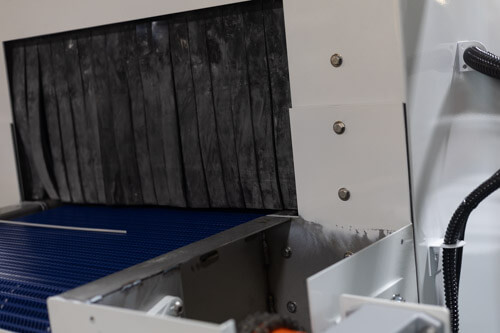
Newer I-Series designs incorporate features such as removable curtains and easier-to-remove spray components.
Previously, replacing certain curtains could require maintenance personnel to work inside the machine and remove numerous fasteners.
Newer designs allow curtain assemblies to be removed much more easily and worked on outside the machine.
Electrical systems follow the same philosophy.
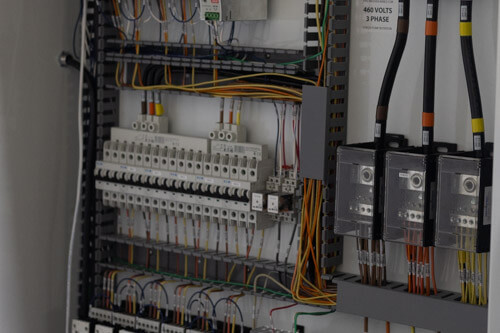
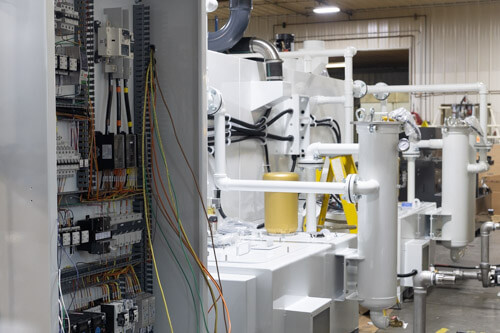
Components are labeled. Electrical enclosures are organized. Documentation identifies parts and service points. The HMI can display information such as tank levels, filter pressures and temperature trends and provide diagnostic information useful for troubleshooting.
Derek described the thinking behind those decisions:
“When we’re designing these machines, we’re thinking: If I had to work on this machine, how would I want it designed?”
— Derek Tylka, Sales Engineer
Those details may not make the part cleaner on day one.
But they can make maintaining the cleaning process much easier over the life of the machine.
Same I-Series Platform. Three Different Answers.
Put these three projects next to each other and the difference becomes clear.
One manufacturer needed a highly specified system with continuous filtration, automated waste handling and additional material handling designed around uptime and production flow.
Another needed Renegade to determine the right combination of wash, rinse, blowoff, heated dry and oil management to achieve the required result.
The third needed to meet a stringent cleanliness specification while controlling machining chips and preventing wash solution from contaminating the rinse process.
Those requirements resulted in different machines because they were different problems.
- Wash.
- Rinse.
- Fresh-water rinse.
- Blowoff.
- Heated dry.
- Filtration.
- Oil separation.
- Material handling.
- Automation.
Those are not simply a list of unnecessary options to add to a conveyor washer.
They are tools Renegade can apply when the production process requires them.
When Standard Stops Fitting the Requirement, That Is Where the I-Series Begins
There is no benefit in adding complexity just to build a more complicated machine.
There is also no benefit in removing something the application actually needs simply to lower the initial equipment price.
The goal is the right cleaning process for the part, production rate and required result.
For one manufacturer, that may be a straightforward wash-rinse-dry conveyor.
For another, it may require continuous filtration, multiple blowoffs, oil separation, specialized material handling and integration with an automated production line.
Different production problems should result in different cleaning solutions.
That is what these three I-Series projects demonstrate.
So when a standard washer no longer fits the requirement, Renegade does not start by asking which machine to sell in their product line.
Your project’s needs.
The part.
The contamination.
The production rate.
The cleanliness requirement.
And what needs to happen next.
Then we provide the I-Series around your process.