
If you’re new to parts washers, you’re in the right place.
Everyone starts the same way, with a dirty part in hand and a question in mind.
So let’s walk through it from the beginning, straightforward and simple.
What a Parts Washer Really Is
A parts washer is just a machine that cleans parts.
Oil, grease, grit, coolant — it takes that off and gives you something you can put back to work or send to the next step.
That’s the whole job.
If it does that day after day, it’s doing what it’s supposed to do.
How Most Parts Get Cleaned Today
Most modern washers use aqueous cleaning.
That means a hot water and detergent solution being sprayed on your parts.
No solvent tanks.
No special handling.
Safer for the people around it and easier to manage in the shop.
The detergent is what actually breaks down the oil and grime.
Think of it as soap for metal. A good detergent cleans without attacking the part or the washer.
When you hear solvent-free, that just means no petroleum-based chemicals.
Less risk. Less paperwork. Less trouble down the road.
The Wash Cycle
Every washer runs on a wash cycle. Some have additional rinse and dry functions.
Some cycles are short.
Some take longer.
The point isn’t speed for its own sake. The point is clean parts that don’t come back.
Manual vs. Automatic Washers
A manual parts washer is one where the operator does the work.
You load the part, scrub it, turn it, and decide when it’s clean.
Common in maintenance shops and low-volume work.
An automatic parts washer runs a programmed cycle once the door closes.
Same process every time.
That’s where consistency comes from.
How Parts Get Loaded
A top load washer opens from the top.
Good for smaller parts and batch cleaning.
A front load washer opens from the front.
Usually used for heavier parts or when using a forklift or hoist
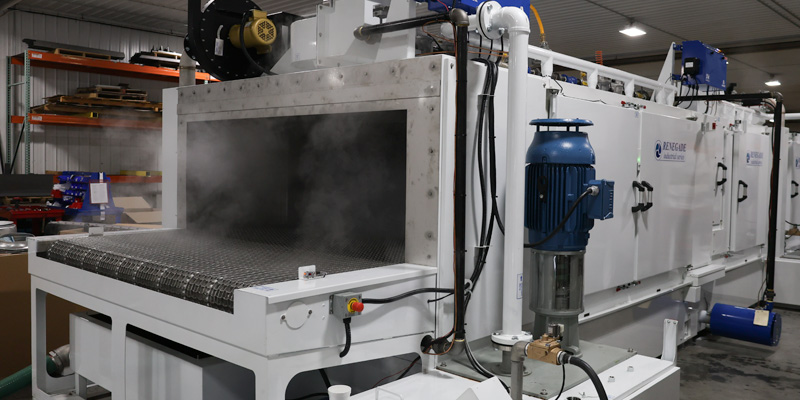
If parts are moving continuously, that’s when you see conveyor or pass-through washers.
Parts go in one side and come out clean on the other.
Cleaning becomes part of the line instead of a separate task.
How the Cleaning Actually Happens
Most industrial washers rely on high-volume spray.
Pumps push heated solution through nozzles and onto the parts.
Pressure replaces scrubbing.
Coverage replaces guesswork.
Heated cleaning just means the water is warm enough for the detergent to work properly and aids in removing grease quickly.
Cold water will clean eventually, though not as thoroughly. Heat ensures the wash process is predictable.
Every machine has a load capacity — the weight or size it’s designed to handle at once.
Exceed that and you don’t get better cleaning. You get repeated wear and tear.
Rinsing and Drying
After washing comes the rinse system.
That removes leftover detergent so residue doesn’t stay on the part.
Some systems reuse water.
Some don’t.
It depends on the process and what the part needs next.
The next step in the process is the drying system — usually heated air or blowers.
The goal is simple: parts come out ready to go back to work.
The Controls
A PLC (programmable logic controller) is the brain of the washer.
It runs the same sequence every time.
The HMI (human machine interface) is what the operator sees — the screen or panel used to start cycles and check status.
It doesn’t need to be clever.
It needs to be clear.
The Term That Matters Most: Clean Specification
A clean specification is the level of cleanliness the part actually needs.
Not “looks clean.”
Not “good enough.”
The level required for what comes next — coating, assembly, inspection, or reuse.
Good washers are built around that result, not around (additional, fancy?) features.
Custom or Engineered Solutions
When you hear custom or engineered solution, it just means the washer is designed around your parts, your workflow, and your reality.
Not around a catalog page.
When cleaning is part of your process, proper fit matters.
What All These Terms Are Pointing To
After you’ve been around parts washers long enough, you stop caring about the words.
You care about:
- Clean parts
- Less waiting
- No drama
- A machine that keeps running
That’s what all these terms are really about.
Everything else is just vocabulary.
Core Parts Washer Terms
Parts Washer
Industrial cleaning equipment used to remove contaminants like grease, oil, dirt, and debris from parts and components before finishing or assembly.
Aqueous Cleaning
A water-based cleaning process using detergents combined with heat and mechanical action, considered safer and more eco-friendly than solvent-based cleaning.
Detergent
Cleaning chemical used within parts washers to break down oils, grime, and contaminants. Often formulated to be solvent-free and environmentally safer.
Solvent-Free
A description of detergents and processes that avoid petroleum-based solvents for safer operation and reduced environmental impact.
Clean Spec
The required level of cleanliness for a part after washing, based on the application or industry standard.
Parts Washer Styles & Configurations
Manual Parts Washer
A basic parts washer that requires an operator to manually place, scrub, or manipulate parts during cleaning.
Automatic Parts Washer
A washer that performs washing cycles with minimal manual intervention, often programmable for specific cleaning tasks.
Front Load Washer
A parts washer where parts are loaded from the front, typically in an enclosed cabinet with a door. Useful for heavy or bulky parts.
Top Load Washer
A parts washer where parts are loaded from the top, common for general repair and smaller part cleaning tasks.
Pass-Through Conveyor Washer
An industrial system where parts are continuously fed on a conveyor through wash, rinse, and dry stages.
Industrial Automated Production Washer
High-production washing systems designed for continuous cleaning of complex or high volumes of parts.
I-Series Parts Washer
A customizable industrial series referenced on the site, designed for complex industrial cleaning needs.
Process & Equipment Features
Wash Cycle
The complete sequence of washing steps (wash, rinse, dry) carried out by a parts washer.
High-Pressure Spray Manifold
A system of high-pressure nozzles directing cleaning solution onto parts for thorough contaminant removal.
Heated Cleaning
Using heat to improve detergent effectiveness and dissolve grease and oil more quickly.
Load Capacity
The maximum weight or volume of parts a washer can effectively clean in a single cycle.
Programmable Timer
Allows users to set cleaning cycles, including heaters and oil skimmers, based on production needs.
Optional Enhancements
Stainless Steel Construction
Upgraded material option for cabinets to resist rust and contamination — critical for specialized or sensitive applications.
Rinse Options
Different rinse methods like “rinse to overflow,” “rinse to pump-out,” or “closed-loop rinse” to remove detergents and residues.
Drying Systems
Includes heated drying cycles or centrifugal blowers to remove water from parts post-wash.
Agitation Dip Tank
A submersion cleaning option where parts are agitated in a tank for deep cleaning.
Flush-Through Washer
A system that pushes cleaning solution through internal channels of parts for thorough cleaning.
Control & Automation Terms
HMI Control Panel
Human-Machine Interface — a touchscreen control interface for operating complex washer functions.
PLC (Programmable Logic Controller)
Industrial controller used to automate washing sequences and integrate with other systems.
Load Handling Interface
Controls or sensors for automated loading/unloading, often integrated with robots or conveyors.
Overhead Jib Crane
An option to assist in safely loading heavy parts into the washer.
Safety & Regulatory Terms
Safety Data Sheet (SDS)
Documents that provide health, safety, and environmental information about detergents and cleaning chemicals.
Eco-Friendly
Describes systems or detergents designed to reduce environmental impact and improve worker safety.
Quick Answers About Parts Washers
What is a parts washer?
A parts washer is equipment used to remove oil, grease, grit, coolant, dirt, and other contamination from parts so they can be repaired, reused, inspected, assembled, coated, or sent to the next step.
What is aqueous parts cleaning?
Aqueous cleaning uses heated water and detergent to clean parts. The detergent breaks down oil and grime while heat and mechanical action help make the process more effective and repeatable.
What is the difference between a manual and automatic parts washer?
In a manual washer, the operator handles and scrubs the part during cleaning. An automatic washer runs a programmed cleaning cycle after the parts are loaded, providing a repeatable process with less operator involvement.
What is the difference between top-load, front-load, and pass-through washers?
Top-load washers are commonly used for smaller batch-cleaning applications. Front-load washers are often used for heavier or larger loads. Pass-through or conveyor washers move parts through the cleaning process as part of a production flow.
What is a clean specification?
A clean specification is the level of cleanliness the part actually requires for the next step, such as coating, assembly, inspection, or reuse.
Key Takeaway
Parts washing comes down to a few basic questions: what is being cleaned, what contamination must come off, how the parts are handled, how many must be processed, and how clean they need to be. The right washer uses the appropriate combination of water, detergent, heat, spray action, cycle control, rinsing, drying, and handling to produce that result consistently.