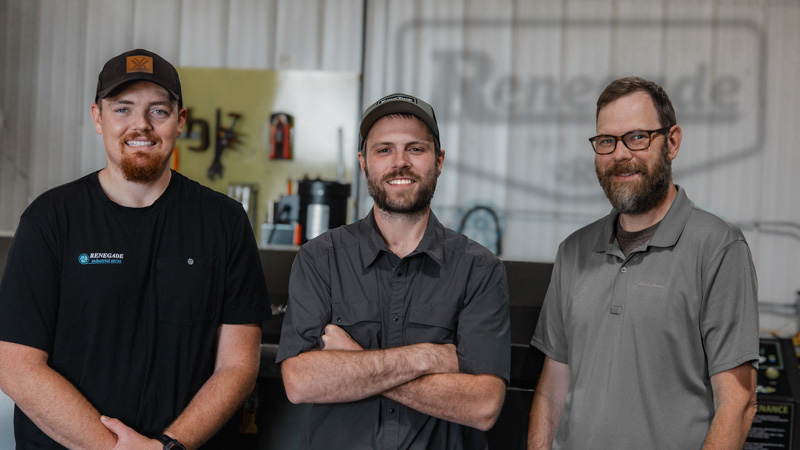
Tyler Mason, Ryan Ewing, and Ryan Kruse help turn customer cleaning challenges into custom Renegade washer solutions.
The Engineers Behind Renegade’s Parts Washers
Every parts washer starts with a simple question:
At Renegade, the answer does not come from a catalog. It comes from looking closely at the customer’s parts, the contamination being removed, the workflow around the washer, the available space, the cycle-time expectations, the utilities, the maintenance needs, and the way the machine has to fit into the larger operation.
That is where Renegade engineering gets to work.
Behind every custom industrial parts washer is a team solving the kind of problems most people never see: how to move debris out of the tank, how to protect a pump, how to dry a difficult part, how to make maintenance easier, how to fit more capability into less floor space, or how to integrate a washer into a robotic production cell.
We asked Ryan Ewing, Tyler Mason, and Ryan Kruse to share what goes into designing custom Renegade washer solutions. Ryan Ewing and Tyler Mason are mechanical engineers, and Ryan Kruse is an electrical engineer. Their answers show how much thought goes into every machine before it ever reaches a customer’s floor.
Custom Washer Design Starts With the Real Cleaning Problem
For Ryan Ewing, one of the most interesting parts of designing an I-Series industrial parts washer is that every project starts fresh.
“No parts washer is the same. Issues that were resolved for a previous customer don’t always work for the next. It’s like a treasure hunt for the proper solution.”Ryan Ewing
That mindset is important because custom washer design is not about adding complexity for the sake of it. It is about building the right system around the customer’s actual process.
Sometimes that means a special fixture. Sometimes it means a wash-rinse-dry process. Sometimes it means rust preventative, robotic loading, custom controls, or a production-line configuration.
Many of those functions can be configured through Renegade parts washer options, including custom fixtures, water management, filtration, load handling, automation, and safety features.
The goal is always the same: clean the part reliably, protect the process, and make the machine work in the real world.
Ryan Ewing pointed to one project involving oscillating blades that needed to be dipped in rust preventative and dried just the right amount. It stands out because the challenge was specific, and the solution had to match the customer’s part and process exactly.
That is the kind of work Renegade engineers enjoy: taking a cleaning challenge that is not off-the-shelf and turning it into a machine that performs every day.
The Best Design Details Are Often the Ones Customers Never Have to Think About
A well-designed parts washer should make the customer’s job easier. That means some of the most important engineering decisions are not the most obvious ones.
Ryan Ewing mentioned overflow port design, adjustable roller supports, anode rods, sump sweeps, and pump strainers as examples of details that matter.
A pump strainer may sit below murky sump water where most people never see it, but it helps protect the pump from large debris. Adjustable roller supports may not stand out at first glance, but they can make a meaningful difference in how parts are handled and supported inside the machine.
Tyler Mason pointed to Renegade’s overall approach to robust design.
“All of our machines are designed to be very robust. Everything is overbuilt so a customer never has to worry about the machine’s longevity.”Tyler Mason
That philosophy shows up in the non-glamorous features too.
Tyler called out sump sweeps and filtration as unsung heroes. A sump sweep helps keep the tank cleaner and can allow the solution to last longer. Filtration helps manage the contamination being removed from the parts.
Filters, drain bags, oil towels, detergents, additives, and other parts washer supplies also support solution management and day-to-day maintenance.
These are not flashy features, but they support uptime, cleaning consistency, and long-term performance.
Ryan Ewing summed it up well:
Parts washing is really contamination management.
Grease, carbon, metal fines, and debris do not simply disappear. A good washer moves them off the part and into a system designed to capture and handle them safely.
Controls, Sensors, and Automation Make the Machine Smarter
Custom washer design is not only mechanical. Controls and automation play a major role in how a washer performs, how operators interact with it, and how easily the customer can maintain it.
Ryan Kruse shared one example that is now built into Renegade’s automated general cleaning washers: a user-settable maintenance prompt. This allows customers to set their own maintenance intervals for solution changes or other service needs.
Renegade’s automatic front-load parts washers and automatic top-load parts washers are built for repeatable daily cleaning, with controls and options that support different shop requirements.
That matters because every application is different. One part may carry light oil. Another may bring in heavy grease, carbon, chips, or fines. Giving the customer control over the maintenance interval lets the washer better match the reality of their process.
Ryan Kruse also described a small but important change to water-level sensing. Renegade previously used sensors wired as a normally open signal. The team later changed to a normally closed signal to make the system more fail-safe.
Now, if a sensor or wiring issue occurs, the washer can better protect itself from overfilling or running with insufficient water, while displaying a sensor failure fault on the PLC screen.
Most customers may never think about that wiring detail. But it matters.
It is the kind of improvement that makes a machine safer, smarter, and more dependable.
Sometimes the Biggest Challenge Is Fitting More Machine Into Less Space
Tyler Mason said one challenge comes up again and again: footprint.
“Customers want a lot of machine in a very tight footprint. This can create many challenges. It is always very rewarding when you can come up with a solution to get all the things the customer wants in a very small package.”Tyler Mason
That challenge is common in manufacturing environments. Floor space is valuable.
A washer may need to include wash, rinse, dry, filtration, guarding, tanks, controls, loading access, maintenance access, and safety features while still fitting into an existing production layout.
Good engineering is not just about making a machine smaller. It is about making sure the washer still performs, remains serviceable, keeps operators safe, and fits the customer’s workflow.
That is where experience matters.
Custom Washers Have to Work With the Entire Production Cell
Ryan Kruse shared a project that shows how important flexibility can be.
Renegade recently built an automated production parts washer with a servo-controlled two-position turntable.
The goal was to allow one part to be washed while the other side was unloaded and reloaded robotically. After fabrication, the customer and their robotics integrator ran into an issue that required a change to the robot tooling.
The new tooling would no longer fit into the front of the washer as originally designed.
Because Renegade had designed the washer with a servo-controlled turntable, the team was able to move the turntable to the side and precisely control the new positioning.
The change increased cycle time, but it allowed the production cell to move forward without mechanical design changes and without a lead-time delay.
The washer has to clean the part, but it also has to work with the equipment around it.
For Ryan Kruse, seeing Renegade washers installed as part of larger automated production lines is one of the most rewarding parts of the job.
“I enjoy seeing our washers in these advanced production cells.”Ryan Kruse
Standardization Still Matters in Custom Engineering
Custom work does not mean every solution has to be rebuilt from scratch. In fact, one of the ways Renegade improves the customer experience is by standardizing the right parts of the machine while still customizing the areas that need it.
Ryan Kruse has worked on standardization and streamlining for Renegade’s general repair parts washer line.
That includes PLC program upgrades that allow a single PLC program to support different combinations of standard features.
The result is a more cohesive operating experience, easier troubleshooting, and the ability to support some field-installed options after the sale.
Features like I/O indication and manual run modes, once found on more advanced I-Series washers, have also been brought into the general cleaning washer line.
That kind of behind-the-scenes work may not be obvious when a customer first sees the machine, but it can make a big difference over the life of the washer.
From Concept to Finished Machine
For the Renegade engineering team, one of the most rewarding moments is seeing an idea become a finished washer.
“An idea, once thought as crazy or impossible, standing there in front of me operational.”Ryan Ewing
That is the heart of custom washer design.
A customer comes to Renegade with a part, a contamination problem, a process requirement, or a production challenge.
The engineering team asks the right questions, works through the constraints, designs around the real application, and helps turn that challenge into a working machine.
Whether the project calls for a custom fixture, a compact footprint, a wash-rinse-dry process, automation integration, fail-safe controls, filtration, or advanced PLC functionality, the goal stays the same:
Build a washer around the customer’s real-world process.
That is where Renegade engineering makes the difference.